
Notes from the Gap

Is dedicating an essay a thing? This one is for you, Jess Serrante. Thank you for your profound company here in the gap.
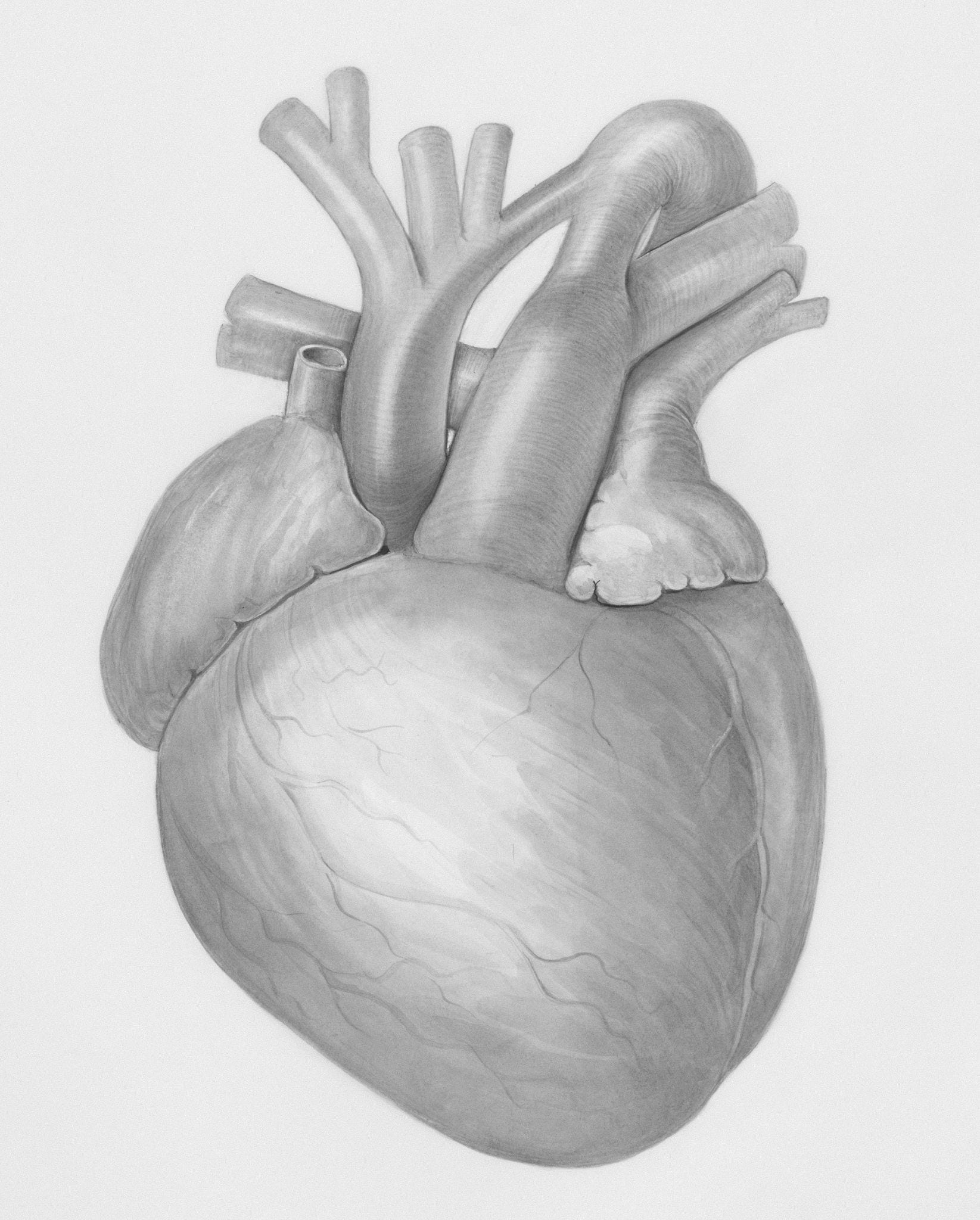
After my brother died, I looked at our life in Vermont with bafflement. That tree now exists without Matt, I thought, staring at the crown of a full maple. This glass of water exists without Matt. This chair. That crow. The stream pool below the bridge where we dip our summer bodies.
I could only grasp death by these small measures of existence.
Though the accident was ten years ago, I can still feel how, like the chair and the crow, my own body became foreign to me. I had to consciously decide to speak, to nourish myself, to lie down at night. In the liminal space of grief, I was no longer governed by the natural rhythms of the day or by my accumulated impulses and habits. I carried myself around like a stranger.
All these years later, I no longer feel like I am moving within someone else’s body through an unfamiliar world, but I never re-entered my old life. In his book In the Absence of the Ordinary, Francis Weller talks about trauma as an encounter with death. “We leave the world that was known,” he explains. “There is a radical alteration in our sense of self… We can never return to the world that was.”
For me, the accident was a threshold. The before-time cleaved away from where I was now stranded. But Weller also talks about the era we are living through as its own kind of threshold. This one is not instantaneous, but “a prolonged season of descent that has taken us down into a different geography. It is a time of gravity and extremes as we witness the hottest temperatures on record, inflamed political discourse, the fraying of social bonds, and the emerging realty of widespread species extinction… It may be decades or more likely a few generations before we see the farther shore of this crisis.”
A threshold, it seems, whether instantaneous or prolonged, delivers a novel world. Everything in this new reality requires a new knowing—the old knowing no longer applies. And in this passage, we meet ourselves anew, too, as we come into the company of our grief for the dying and our longing for what Weller calls “the farther shore.”
*
One of the agents I queried about my half-baked book, Ordinary Animal, was interested, but worried. She described the feeling of reading the excerpt I sent her as a kind of claustrophobia. A discomfort with the feeling of… well… grief.
Would readers have the same experience?
I get it. I had, after all, sent her pages reckoning with my choice to have children amidst the sixth extinction. This is the territory of admission. Opening our eyes wide enough to see that we are, undeniably, living through what Joanna Macy, the eco-philosopher and scholar of Buddhism, termed The Great Unraveling, aka “the ongoing collapse of living structures.”
“When ecological, biological, and social systems are commodified through an industrial growth society or ‘business as usual’ frame,” Macy explains, they “don’t just fall over dead, they fray, progressively losing their coherence, integrity, and memory.”
This prolonged unraveling means it is still possible to cling to the geography of the old world, and the way things were. “On some level, most of us wish that nagging ache would go away,” Katharine K. Wilkinson writes in her book Climate Wayfinding. “Its rumble complicates our already complicated lives. This is too much, we whisper. And that is true: It is entirely too much.”
I wanted to tell the agent that planetary grief is not a choice, but an inevitability. Even if some of us have the luxury of turning away, our collective children certainly will not. “Grief,” Weller writes, “will be the keynote for the foreseeable future… Primary among the skills we will need to cultivate is our capacity to grieve.” And so along with the inheritance of this warming world, I feel a duty to pass along something about how to live with this sorrow.
But I wanted to express something else, too—an understanding that I was still writing my way into. My acquaintance with existence (a crow, a tree) came on the heels of death. It was this encounter with darkness that allowed me to see life without the usual pretense of its continuance. I shed the numbness of assumption.
Did you know, I wanted to say, that Rachel Carson proffered wonder with tide pools and forests as “an unfailing antidote” even as she catalogued the damaged world of a silent spring?
*
A few nights ago, I led a writing workshop at our local library. It was the last event in a series on climate change and community resilience—topics ranging from wetlands to conservation to emergency preparedness. Like most places in Vermont, our little town is prone to catastrophic flooding, and wildfires are on the horizon now, too. In Trump’s era of climate denial, to have a seven-part series dedicated to this theme was resilience-forging in itself—the gift of coming together on an “island of coherence,” as a friend recently put it.
We began the workshop by looking at how writing and storytelling can move readers beyond knowledge acquisition and into their own deeper well of care. “As a scientist, I know it’s easier to explain how bad a situation is, but far harder to actually feel it,” writes Joëlle Gergis, an Australian climate scientist and IPCC lead author. “That’s where art and storytelling come in. They allow us to have an emotional connection to other humans and the rest of the natural world. They help us feel something, which might trigger a personal experience that leads to broader cultural change in our communities.”
“The writers I love most are almost always on a mission,” writes Julian Aguon, an Indigenous human rights lawyer from Guam. “To save the world one sentence at a time… they offer up their gifts, hoping, as the brilliant black feminist Audre Lorde had hoped, that their words can close some of the gap between blindness and our better selves.”
We talked about how this gap—between blindness and our better selves, but also between the unraveling world and the world of our longing—is where our grief resides. There is an inherent sadness as we acknowledge “that farther shore.” But it is also that acknowledgment that allows us to move toward something different than the way things are. Being numb to our grief means we are also numb to our longing, to our vision for another way.
Gergis reminds us that is it art and storytelling that “have the power to dismantle the walls of numbness.” And, Katharine K. Wilkinson writes, “if we feel into those feelings, we can also touch a desire to make things better,” an innate desire to “arc toward healing.”
There is a duality I want my daughters to understand as their inheritance. Like twin chambers of the heart, our love for the world and our sorrow for its suffering labor in synch, pumping against the dangers of apathy, futility, despair. Our love and grief, just like Carson’s wonder and horror, do not exist independently, but together propel us toward a more just world.
*
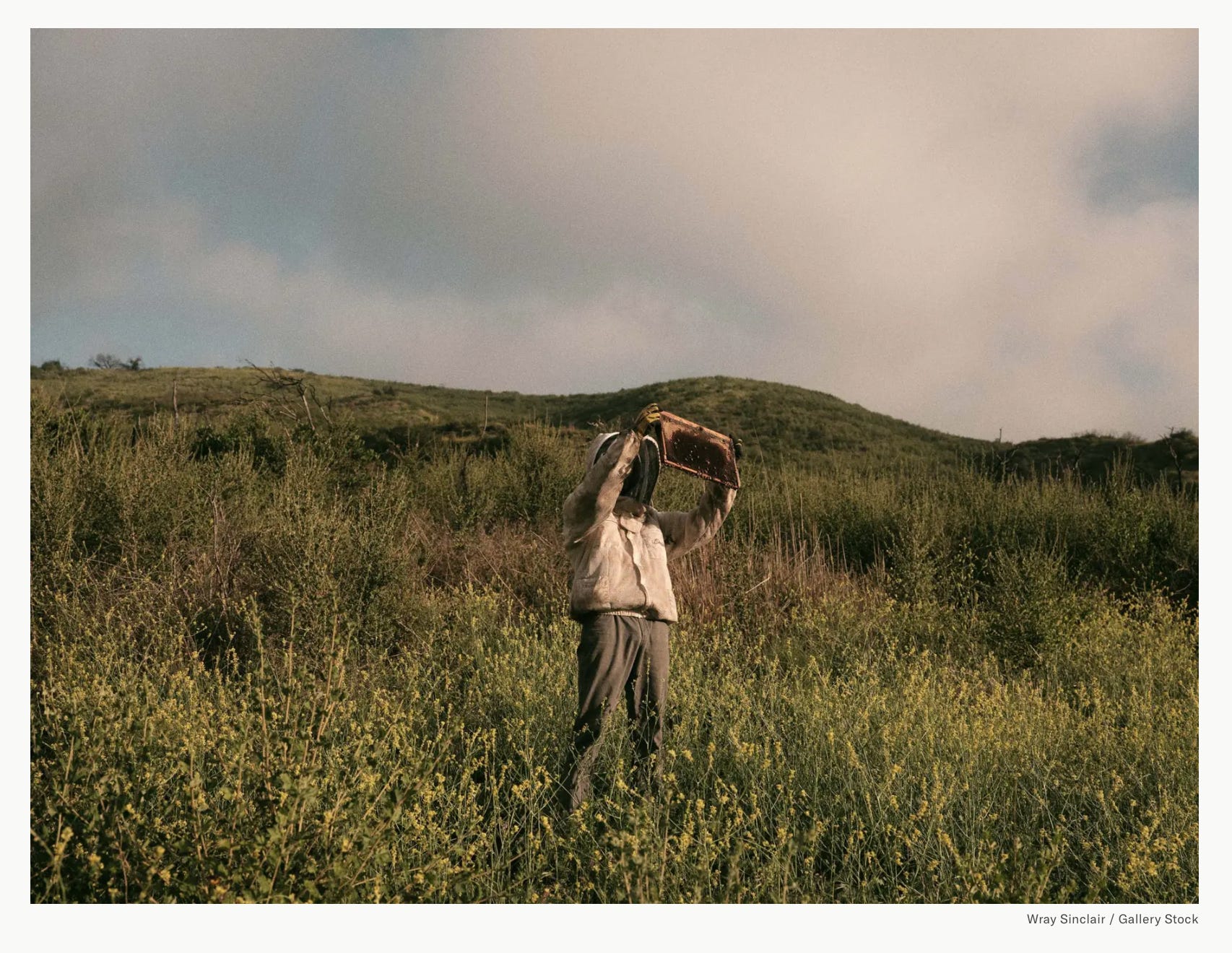
At the library workshop, before I asked everyone to pick up their own pens, we read an exquisite essay by Emily Polk about finding solace in the company of bees. At its end, the grief that has accumulated through the essay builds to a kind of crescendo, and then falls away as Polk’s sorrow is subsumed by the experience of life’s abundance. Here she is, observing Khaled Almaghafi, a bee whisperer, checking on a hive he’s been tending in Oakland, California:
“Watching him, I am suddenly hit with a pummeling sorrow. Sorrow for my country, which cannot imagine its way out of its brokenness; for a warming climate where so much life is being catastrophically destroyed. Sorrow for the lives of so many families suffering from endless war… for the bees who give so much even as they continue to be decimated; for the searing pain of my own losses, thrumming in my bones like a living bruise, an ache for a daughter who will never return. But then the bees are buzzing around Khaled, thousands of them, like golden stars in hallowed autumn light.
“‘They are healthy, these bees,’ Khaled is saying, a soft smile on his face. I start to smile too... They are alive! In their daily travels along Earth’s magnetic fields, in the ways they scream to protect each other, in the ways they adapt and persist in the face of loss—of land, of clean air, of familiar flowers—they show us what it means to survive. In the tenacity and grace of their daily lives, they survive. This is the miracle that connects me to the bees, the thread that connects all of us wild creatures who are still breathing—it’s not the inevitability of loss and grief, but the astonishing revelation that somehow we’ve managed to survive in the face of it.
“‘Look closely you can see where the queen laid the eggs,’ Khaled says. ‘There will be new bees there.; He is covered in them, the promise of them, the song of them, their honey breath and ancient bodies. I am dizzy with the sight of it, the courage of it, of how much life is in front of me trying to survive as best it can all the time, the dizziness makes my head spin until I think I too must be the persimmon tree bearing her orange sunsets, the hive box filled with buzzing, the sage smoke and the bee itself, I am also the bee with honey breath in an ancient body, flickering in this short life for a half-breath of a second against the blue bowl of sky, and beyond that, eternity.”
Polk’s description echoes an observation from Weller about those threshold experiences that break “us into a wider and more inclusive experience of self. We become part canyon, part meadowlark, part cloud bank, part village.”
It is through the rawness of grief that our separate self falls away, and we feel ourselves as porous, a part of the world rather than distinct from it. “We fall in love with the world,” Weller says, “and learn to protect what we love.”
Perhaps, I realize now, this is what was at the core of the agent’s feedback. In that early draft, I had taken her on a dead-end road. I hadn’t shown her where grief leads.
*
Eleven months after my brother died, my first daughter was born. This was a threshold, too. The instant she emerged from my body and entered the cold hospital air of the outside world, a smallness about myself unfurled. In this new state of motherhood, the walls of containment expanded beyond me so that I was no longer a singular body, or rather, no longer cared so much about the singular body of self. The feeling was akin to being thrashed by salty gusts on the edge of the sea.
The birth of my first daughter eradicated a solipsism I hadn’t even known was there—a doctrine of modernity that I’d internalized: metering my own worth as a sole impermeable human body, a bounded self. With a newborn animal at my breast, I could sense myself—sense all of us, humans—in the sweep of lateral life, in the depth of evolved life, surrounded as we are by fins and feathers, scales and fur.
For the first time I felt myself not as a countering, dangerous force, but one amongst many. Subject to the same pull of the tide and turn of the seasons, the same surging storms, raging winds, smoke-choked air, and warming waters. We are—like chickadees, like lobsters—embodied beings, buffeted and sustained by these forces in equal measure. We are not extractable from the rest of life. The philosopher Crispin Sartwell wrote that “Our supposed fundamental distinction from ‘beasts,’ ‘brutes’ and ‘savages’ is used to divide us from nature, from one another and, finally, from ourselves.”
I had been cowed by death’s spontaneity, by its finality. Brutalized. Giving birth did not change any of that. But the one-two-punch endowed what felt like a foundational, unshakable truth: that the forces that govern our lives are indiscriminate, unforgiving, and that they will govern the lives of my children too. All of us animals.
“Our times,” Weller writes, “remind us of something inevitable but strangely denied: we are vulnerable, interdependent animals, clinging delicately to our little thread of life.” Perceiving ourselves as small, exposed, and therefore dependent on other forms of life, counterintuitively makes us feel vast: a part of something so much greater than our one small self.
“To become immense,” Weller explains, “means to recall how embedded we are in an animate world—a world that dreams and enchants, a world that excites our imaginations and conjures our affections through its stunning beauty. Everything we need is here.”
Crown of a full maple. Glass of water. Chair and crow. Stream pool below the bridge, where we dip our summer bodies.
What a thing it is to be alive on this exquisite and hearbreaking planet in this time with you, dear @Liza Cochran! I'm humbled by this dedication and so moved by your depth, your seeing your ever evocative way with words.
My goodness, that hit me right in the heart. Frankly, many individual lines did just that, prompting me to reread and savor a number of sentences. Grief touches us all in unique and shared ways. The more it's talked about and shared out loud, the softer it becomes. Thank you. Well-timed.